AI is making software cheaper to build. But building software was never the hardest part of running it.
Artificial intelligence is changing software engineering faster than most of us expected. Tasks that once required hours of coding can now be completed in minutes. AI coding agents can explore repositories, implement features, generate tests, review code, and even help deploy applications.
For software engineers, this creates an uncomfortable question:
If AI can write code increasingly well, what skills will make an experienced engineer valuable in the long run?
One common response is to chase the next technology trend: learn a new framework, master another AI tool, or move into a supposedly future-proof specialization.
But I believe we should start somewhere else.
Instead of asking what AI can do, we should examine the problems businesses cannot afford to get wrong.
Companies do not hire experienced engineers simply because they can write code. They need people who can navigate ambiguity, make consequential technical decisions, manage risks, diagnose failures, and take responsibility for systems that affect real customers and business operations.
AI can help with all these activities. In many cases, it can perform substantial parts of the work. But generating a plausible solution is not the same as establishing that the solution is correct, safe, economical, and suitable for a particular business.
Here are seven fundamental enterprise problems that explain why deep engineering expertise will continue to matter—and six capabilities software engineers should develop to address them.
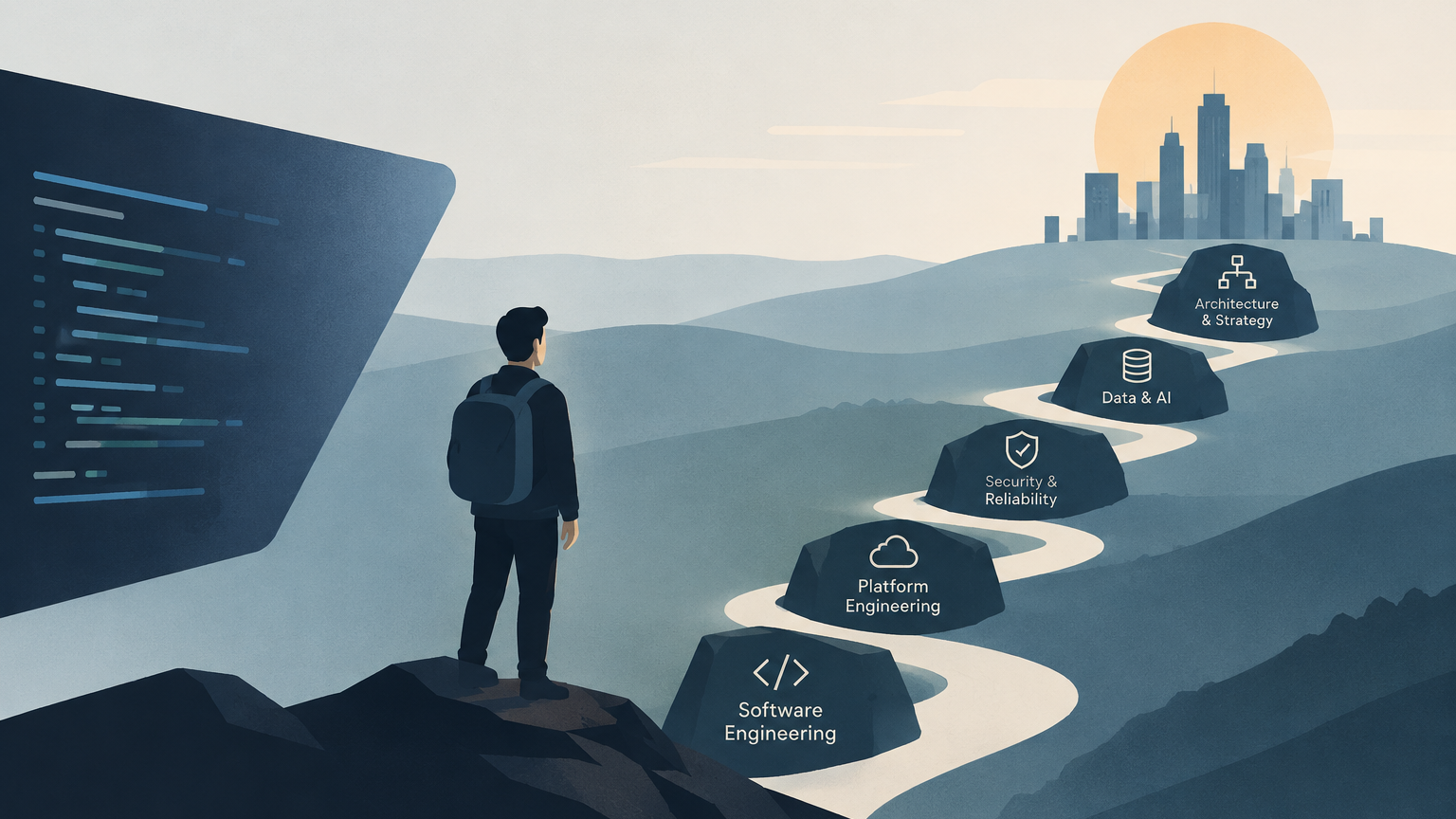
The 7 Core Problems Enterprises Must Solve
1. Production Failures That Nobody Can Easily Explain
A system can pass every test in development and still fail in production.
A database becomes unexpectedly slow. A background queue accumulates millions of jobs. A deployment causes intermittent errors. Two services disagree about the state of a transaction. A system works perfectly under normal traffic but collapses during a sudden spike.
The hardest incidents are rarely caused by a single obvious bug. They emerge from interactions between databases, networks, caches, asynchronous jobs, third-party services, infrastructure, and application logic.
AI can analyze logs, suggest likely root causes, generate diagnostic scripts, and recommend fixes. These capabilities can dramatically accelerate incident response.
However, an engineer must still determine which evidence is trustworthy, distinguish symptoms from root causes, understand the blast radius, and decide whether a proposed fix is safe to deploy.
In a critical incident, the question is not simply, “What code should we change?”
It is:
- What actually failed, and why?
- Which customers and business processes are affected?
- Can we mitigate the problem without introducing a larger failure?
- How do we know the system has recovered?
- What changes will prevent the same class of incident from recurring?
The expertise that matters: Distributed systems, debugging, observability, Site Reliability Engineering (SRE), incident management, capacity planning, and disaster recovery.
The value of an experienced engineer is not that they never encounter failures. It is that they can reduce the time, cost, and uncertainty involved in recovering from them.
2. Security Vulnerabilities and Broken Trust Boundaries
A feature can work exactly as designed and still create a serious security vulnerability.
An API may expose another customer’s records. A background job may execute with excessive permissions. A compromised credential may grant access to an entire environment. A seemingly harmless AI agent may invoke a tool that performs an unauthorized action.
These problems are particularly dangerous because they are not always visible through ordinary functional testing.
AI can generate authentication code, identify suspicious patterns, and recommend security improvements. Yet security depends on understanding the complete system: its assets, trust boundaries, identities, permissions, data flows, and potential attackers.
Someone must determine what each component is allowed to do—and what must remain impossible, even when a component behaves unexpectedly.
For example, asking an AI agent not to modify production data is not an adequate security control. A robust design enforces permissions outside the agent’s own instructions.
The same principle applies to conventional applications: authorization must be enforced by the system, not merely assumed by its developers.
The expertise that matters: Security architecture, authentication and authorization, identity and access management (IAM), threat modeling, least privilege, secrets management, auditability, application security, and AI security.
Security is not a checklist that can be completed once. It is a set of constraints that must remain effective as the system evolves.
3. Modernizing Legacy Systems Without Disrupting the Business
Many enterprises depend on systems that were built years or even decades ago.
These systems may contain undocumented business rules, fragile integrations, outdated dependencies, inconsistent data models, and assumptions that nobody remembers making.
Replacing them is rarely as simple as rewriting the code in a modern framework.
A database migration can introduce data inconsistencies. A new API can break existing clients. A supposedly redundant service may support an undocumented business process. A migration that looks technically elegant may be too risky to execute within the company’s operational constraints.
AI can accelerate code analysis, documentation, test generation, and the implementation of replacement components. It can make legacy modernization more affordable than before.
But it cannot automatically establish that every hidden business dependency has been discovered or that a migration will preserve all the behavior the business relies on.
That requires a deliberate strategy:
- Discover the actual behavior of the existing system.
- Identify critical dependencies and undocumented rules.
- Define data consistency and compatibility requirements.
- Migrate incrementally where possible.
- Establish validation, rollback, and recovery mechanisms.
- Verify the outcome against real business expectations.
The expertise that matters: Database internals, domain modeling, system integration, backward compatibility, data migration, distributed transactions, and incremental modernization strategies.
The goal is not merely to replace old technology. It is to improve the system without destroying the business knowledge embedded within it.
4. Scaling Without Letting Complexity and Costs Spiral
A system that works for 100 users may behave very differently when it serves 100,000.
More traffic introduces new bottlenecks. More services create more operational dependencies. More data increases storage and query costs. More teams introduce coordination overhead. More infrastructure creates more opportunities for configuration errors.
Cloud infrastructure can scale resources automatically, but automatic scaling does not guarantee economic efficiency or architectural correctness.
A poorly designed system can scale its waste just as efficiently as it scales its useful capacity.
AI may recommend caching, database indexing, service decomposition, or additional infrastructure. However, the right decision depends on workload characteristics, latency requirements, consistency guarantees, failure tolerance, operational capability, and business economics.
Sometimes the best solution is a more sophisticated architecture. Sometimes it is a simpler application with a better database schema.
The engineer must understand the difference.
The expertise that matters: System design, performance engineering, database optimization, capacity planning, cloud architecture, infrastructure automation, and FinOps.
The objective is not to build the most technically impressive architecture. It is to build a system that meets its requirements at an acceptable level of complexity and cost.
5. Turning AI Capabilities Into Reliable Business Systems
AI introduces a new category of engineering challenges.
A model may produce a convincing but incorrect answer. An agent may select the wrong tool. A workflow may repeat an action after a timeout. A model update may change behavior that previously passed evaluation. A retrieval system may return irrelevant information that the model presents confidently.
These are not merely prompt-engineering problems. They are system design, verification, security, and operational problems.
Consider an AI agent that processes customer requests and updates a CRM.
The agent may correctly understand the request but select the wrong customer record. It may call the correct API with incorrect parameters. It may report success even though the operation failed. It may retry an operation that has already been completed.
A production-ready implementation needs more than a capable model. It needs explicit permissions, input validation, bounded actions, reliable integrations, postcondition checks, audit logs, and a strategy for handling uncertainty.
Depending on the consequences, it may also require human approval before executing an action.
This is where AI engineering becomes fundamentally different from simply connecting a model to an application.
The expertise that matters: AI system architecture, model evaluation, workflow orchestration, tool permissions, deterministic verification, observability, fault tolerance, and human-in-the-loop design.
The important question is not whether an AI system can complete a task in a demonstration.
It is whether the system can complete the task reliably, within defined boundaries, under realistic conditions—and provide evidence that it did so correctly.
6. Making High-Impact Decisions With Incomplete Requirements
Not every engineering problem begins with a clear specification.
A stakeholder may request a new feature without understanding the underlying problem. Different departments may have conflicting expectations. A product requirement may omit important edge cases. A seemingly minor implementation choice may determine the system’s cost and flexibility for years.
AI can generate requirements, propose architectures, compare alternatives, and identify potential gaps. It is particularly useful for exploring options and making implicit assumptions visible.
But it cannot independently determine every business priority or resolve every conflict between stakeholders.
Should the system prioritize speed of delivery or long-term maintainability? Is eventual consistency acceptable for this workflow? Should a feature be configurable or standardized? Is a proposed optimization worth the additional operational burden?
These questions depend on context, constraints, risk tolerance, and business objectives.
An experienced engineer must translate ambiguous requirements into explicit decisions, explain trade-offs, challenge flawed assumptions, and make sure stakeholders understand the consequences.
Useful practices include architecture decision records (ADRs), explicit assumptions, domain modeling, decision matrices, and clearly documented acceptance criteria.
The expertise that matters: Requirements engineering, domain-driven design, architecture evaluation, technical communication, risk analysis, and stakeholder management.
The ability to write code is valuable. The ability to determine what should be built—and why—is often even more valuable.
7. Knowing Whether a System Is Actually Ready for Production
AI can generate code quickly. It can also generate tests, documentation, deployment scripts, and configuration files.
But the existence of these artifacts does not prove that a system is production-ready.
A passing test suite may not cover important failure scenarios. A security scan may miss a design flaw. A successful deployment may still leave broken background jobs. A backup process may exist without anyone having verified that restoration works.
This creates a critical distinction between producing evidence and establishing confidence.
A reliable release process defines what must be true before a system can be shipped.
For example:
- Critical business workflows pass meaningful tests.
- Security and authorization requirements are verified.
- Data integrity is preserved.
- Performance meets agreed requirements.
- Monitoring and alerting are operational.
- Rollback and recovery procedures have been tested.
- Known limitations and residual risks are documented.
- The team knows who owns the system after release.
AI can help automate many of these checks. Engineers must decide which checks matter, ensure they test the right properties, and determine how to handle failures.
This becomes especially important when AI-generated changes are produced at a rate that exceeds a team’s ability to review them manually.
The expertise that matters: Test architecture, software verification, CI/CD, release engineering, quality assurance, risk-based testing, operational readiness, and production ownership.
The objective is not to review every line of AI-generated code by hand. It is to build a verification process that provides sufficient confidence before changes reach users.
The 6 Core Capabilities Software Engineers Should Develop
The seven problems above may look different, but they share a common pattern: the difficult part is rarely producing a plausible technical solution. It is understanding the context, controlling the risks, and proving that the solution works.
For engineers who want to remain valuable as AI capabilities advance, I believe six capabilities deserve particular attention.
1. System Design and Distributed Systems
Learn how systems behave beyond the happy path.
Understand concurrency, transactions, isolation levels, caching, queues, idempotency, retries, timeouts, eventual consistency, and failure isolation.
Learn how databases execute queries, why contention occurs, and how a system behaves when dependencies become slow or unavailable.
You do not need to memorize every architectural pattern. You need to understand the underlying trade-offs well enough to recognize when a design will fail and why.
A practical test: Can you explain what happens when a payment request is processed twice, a database becomes unavailable, or two services update related business data concurrently?
2. Security and Trust Boundaries
Learn to reason about what a system must protect and what each component is permitted to do.
Understand authentication, authorization, least privilege, identity management, secrets, encryption, threat modeling, audit trails, and secure software delivery.
For AI-enabled systems, extend these principles to tool access, untrusted input, data exposure, agent permissions, and the validation of actions requested by models.
Do not treat security as a separate phase that happens after implementation. Build it into the architecture and verification process.
A practical test: Can you identify the trust boundaries in your application and demonstrate that a compromised component cannot access resources beyond its intended permissions?
3. Reliability and Production Ownership
Learn to operate systems, not just build them.
Develop practical skills in logs, metrics, distributed tracing, service-level indicators (SLIs), service-level objectives (SLOs), incident response, root-cause analysis, rollback, backup restoration, and disaster recovery.
Understand the difference between a system that appears healthy and one that is meeting its actual service requirements.
Most importantly, practice investigating failures using evidence rather than guessing.
A practical test: If your production service becomes slow at 2 a.m., can you identify the likely cause, reduce customer impact, restore service, and explain what must change to prevent recurrence?
4. Architecture and Technical Decision-Making
Learn to evaluate solutions in the context of the business.
Develop skills in domain modeling, architecture trade-offs, integration design, migration planning, compatibility, technical debt management, and architecture decision records.
Practice explaining why a solution is appropriate—not just why a particular technology is popular.
Good architecture is not about using the newest framework or the most sophisticated infrastructure. It is about choosing a design that satisfies business requirements while managing cost, complexity, risk, and future change.
A practical test: Can you compare two viable designs, explain their trade-offs, and defend your recommendation to both technical and non-technical stakeholders?
5. AI Engineering and Verification
Do not stop at learning how to use AI coding tools. Learn how to engineer reliable systems that use AI.
Understand model limitations, evaluation datasets, regression testing, structured outputs, tool orchestration, permissions, observability, and failure handling.
Distinguish between tasks that can be verified deterministically and those that require probabilistic evaluation or human judgment.
For AI coding workflows, develop a verification pipeline that checks behavior, security, compatibility, and acceptance criteria rather than assuming that a fluent explanation implies correctness.
A practical test: Can you design an AI workflow that detects incorrect outputs, prevents unauthorized actions, verifies successful execution, and handles uncertain results safely?
6. Business Context and End-to-End Ownership
This capability connects the other five.
An engineer who understands only the technical implementation may optimize the wrong thing. An engineer who understands the business can identify which failures matter most, which requirements are essential, and which trade-offs are acceptable.
Learn to ask better questions, uncover hidden assumptions, quantify impact, communicate risk, and distinguish business outcomes from implementation activity.
Ownership means following a problem through the entire lifecycle: understanding it, designing a solution, implementing it, verifying it, operating it, and learning from the results.
A practical test: Can you explain how a technical decision affects revenue, customer trust, operational cost, compliance, or the company’s ability to deliver future changes?
Where Platform Engineering Fits Into This Picture
Platform engineering is one promising path for developing several of these capabilities together.
A well-designed internal platform helps engineering teams deliver software through standardized infrastructure, secure defaults, reusable workflows, automated verification, observability, and self-service capabilities.
Its purpose is not simply to deploy Kubernetes or build another developer portal. It is to reduce the cognitive burden on product teams while improving delivery speed, reliability, security, and operational consistency.
The same principles become increasingly relevant as AI coding agents generate more changes.
If code generation becomes faster, the surrounding engineering system must make it easier to validate changes, enforce policies, detect failures, and deploy safely.
This does not mean every software engineer should become a platform engineer. Nor does it mean platform engineering is immune to automation.
Rather, platform engineering offers a practical environment in which to develop system design, infrastructure, security, reliability, and automation skills.
For engineers who already have strong software development experience, it can be a natural extension—not a complete career reset.
AI platform engineering is another promising direction, combining infrastructure and reliability expertise with the specific requirements of operating AI-powered applications and agentic workflows.
A Practical Development Strategy
Instead of chasing every new technology, build depth through projects that force you to confront real engineering constraints.
A useful sequence is:
Phase 1: Strengthen system fundamentals.
Study databases, distributed systems, concurrency, networking, and failure modes. Practice investigating performance problems and designing systems that handle retries, timeouts, and partial failures.
Phase 2: Learn to operate systems reliably.
Build reproducible environments using containers, CI/CD, infrastructure as code, and observability. Add automated tests, security checks, rollback procedures, and recovery exercises.
Phase 3: Build a platform capability.
Create reusable deployment workflows, secure defaults, configuration management, service templates, and verification pipelines. Focus on making safe delivery easier for other developers.
Phase 4: Apply these principles to AI systems.
Build an AI workflow with restricted tool permissions, explicit policies, evaluation tests, audit logs, and postcondition verification. Test how it behaves when inputs are invalid, tools fail, or the model produces an unexpected result.
Phase 5: Measure outcomes.
Track meaningful indicators such as deployment failure rate, recovery time, infrastructure cost, verification coverage, and the time required to deliver a change safely.
The goal is not to accumulate a long list of technologies on your résumé. It is to develop the ability to design, validate, and operate systems under realistic constraints.

Conclusion: Become the Engineer Who Can Be Trusted With Consequential Decisions
AI will continue to improve. Some tasks that require significant expertise today will become easier to automate tomorrow. No particular job title or technical specialization can guarantee permanent protection from that change.
But businesses will continue to face problems involving uncertainty, security, reliability, cost, competing priorities, and accountability.
The engineers who create the most durable value will be those who can use AI to move faster while maintaining control over the outcomes that matter.
They will know when to trust automation, when to demand stronger evidence, when to simplify an architecture, when to stop a release, and when a decision requires human judgment.
They will not compete with AI solely on the speed of producing code.
They will use AI as a tool while taking responsibility for the systems they help create.
The long-term opportunity is not simply to become better at coding. It is to become better at solving the problems that make software difficult to trust, operate, and scale.
That is the direction I want to invest in: deeper engineering fundamentals, stronger system design, security, reliability, platform capabilities, and disciplined AI engineering.
Not because these skills are guaranteed to be immune to automation, but because they address the problems businesses ultimately need solved.
And that is a much better foundation for a long-term engineering career than chasing the next trend.
What do you think will matter most for software engineers as AI coding agents become more capable: system design, platform engineering, security, AI verification, or something else?